
September Testing: The 2K Row
September is a testing month at Cornerstone, and the first benchmark on the board is the 2,000 meter row. It is simple, honest, and miserable in the best way: eight or so minutes of you against a monitor that does not care how your week went.
Testing is not about ego. It is about getting a number so the next twelve weeks of training have a target. Once you know your 2K, every shorter row inside a workout stops being a guess.
How to pace your 2K
Most people blow up because they open at a pace they can hold for 500 meters, not 2,000.
- First 250m: slightly faster than goal pace, then settle. Do not chase the screen.
- Middle 1,000m: goal pace, breathing controlled, stroke rate 26-30. This is where the test is won or lost.
- Final 500m: start building at 400 to go, empty the tank in the last 200.
- Technique: legs, hips, arms on the drive. Arms, hips, legs on the recovery. Drive with the legs, not the lower back.
If you have never tested, pick a split you think you can hold, add three seconds, and start there. You can always negative split. You cannot un-blow-up.
The full pacing chart
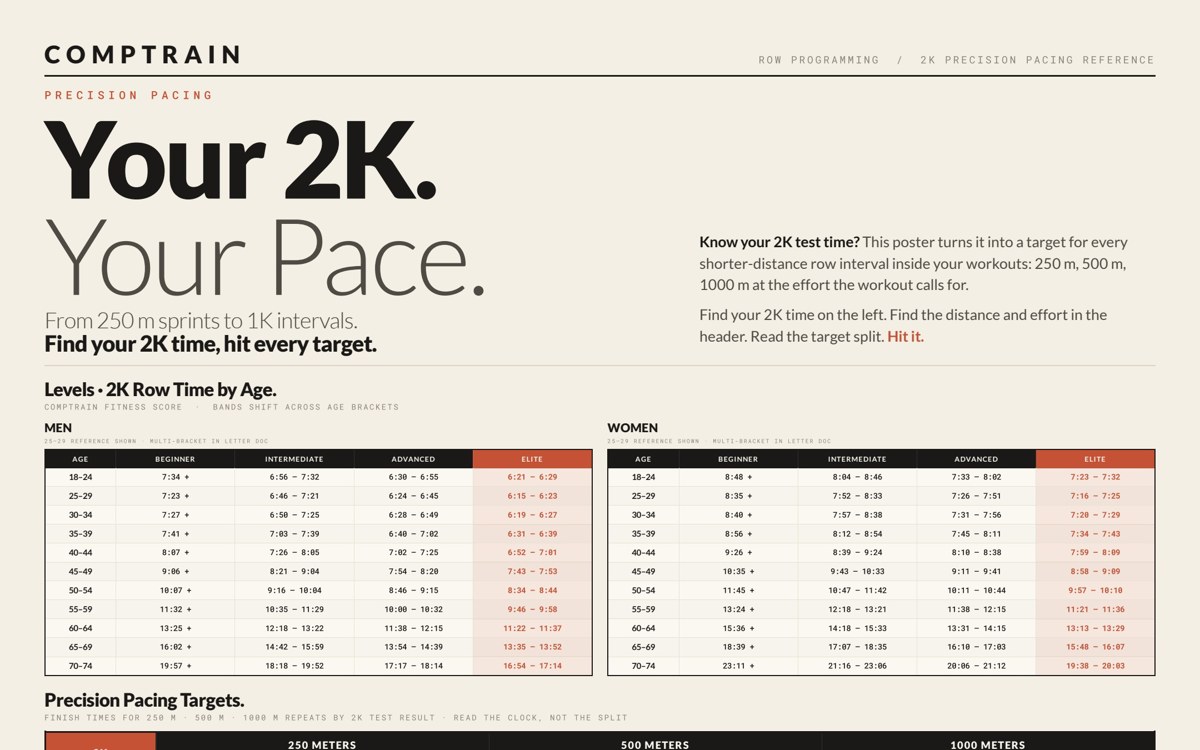
Here is the complete reference poster: age-based benchmark bands for men and women, plus target finish times for the 250m, 500m, and 1,000m rows that show up inside workouts. Read a cell as the elapsed time on the monitor for that piece, not a /500m split.
Effort key: Tempo RPE 6-7 - Race RPE 7-8 (your 2K test intensity) - Hard RPE 9 - Sprint RPE 10.
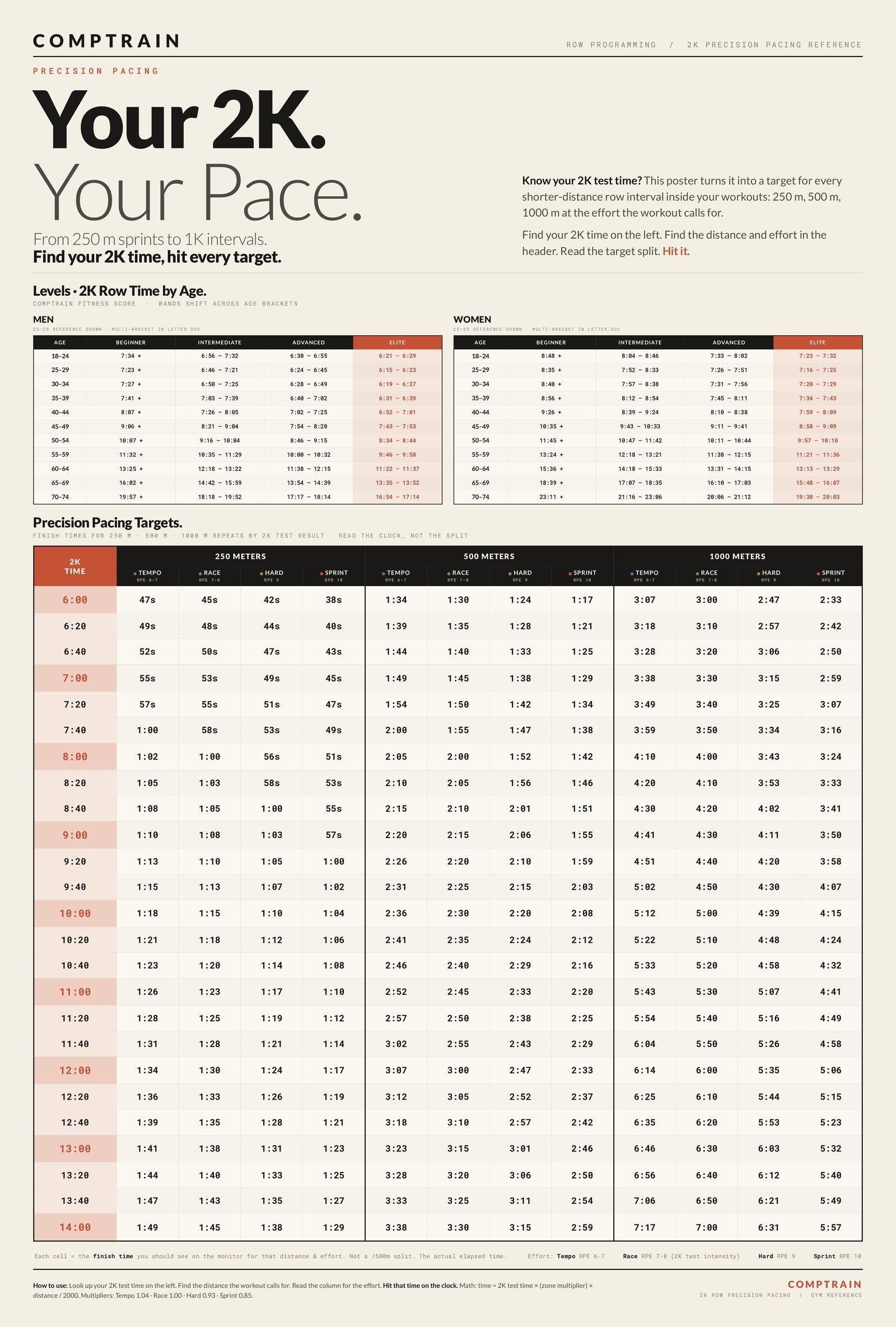
The math behind it: target time = 2K time x zone multiplier x distance / 2000, where Tempo = 1.04, Race = 1.00, Hard = 0.93, Sprint = 0.85.
Print the poster
Download the 2K Row Precision Pacing poster (PDF)
Test day tips
Eat something light 90 minutes out, hydrate all day.
Warm up for at least 10 minutes with a few 10-stroke pickups at goal pace.
Set the monitor to 2,000m, damper 4-6 for most athletes.
Write your number down. We'll test this again, and that is the a comparison worth looking at.
Bring a friend, take your number, and let's build from there.